Thursday, July 16, 2015

Ad-junk?


Bum raps aren’t always fair.  One way or the other, certain aspects of the beer world are given negative connotations they don’t really deserve.  I’ve long been an apologist for the shaker pint, that sturdy, versatile work horse so maligned by the snobs.  I don’t think the three tier system’s such a bad thing, either, as it helps to level the playing field and give more opportunity to the little guys.  I understand people’s criticism of these entities, but can also see the good they offer.

Some bum raps come from misunderstanding or guilt by association.  What does the word ‘adjunct’ conjure for you?  Not long ago, the word became affixed to a style of beer that only recently had to be distinguished & renamed, squeezed between “American” & “Lager”.  American Adjunct Lager is, I believe, meant to be a value-neutral descriptor, indicating the kind of traditional corn- or rice- infused beer your grandfather (& most of America) drinks.  But let’s face it - it’s pretty much a bowdlerism for “shitty industrial beer”. 

The word “adjunct” became taboo not because adjuncts are inherently bad, but because craft fans saw them being abused & came to assume that the sole purpose of using adjuncts was to thin the flavor & cheapen the beer.  The Brewers’ Association, up until last year, excluded from the definition of “craft brewery” any brewer whose flagship contained adjuncts.  The tent has since been expanded – “traditional” now denotes  A brewer that has a majority of its total beverage alcohol volume in beers whose flavor derives from traditional or innovative brewing ingredients and their fermentation.  Traditional or innovative?  Huh?  Anyway, craft brewing now includes those “adjunct brewers” that were theretofore verboten, which essentially means that any domestically-owned brewery making under 6,000,000 barrels a years is a craft brewery. 

But despite being tied to a stigmatized indigenous beer style, adjuncts are not the enemy of good beer.  They don’t exist solely for the purpose of cheapening beer (though have been misused to this effect).  The definition of an “adjunct” in brewing is any source of fermentable sugar other than malt.  This includes corn and rice, yes, but also unmalted oats, rye, wheat, barley, syrups, honey, etc.  Oatmeal stouts are “adjunct beers”, yet you don’t see them scorned as “English adjunct stouts”.  Lambics contain unmalted wheat, yet you don’t see “Belgian adjunct sour ale” being thrown around.  Many, many beloved Belgian ales use candi sugar, yet you’d never see someone disparage Westy 12 as a “Trappist adjunct ale”.  Many, many great beers rely on adjuncts to enhance their character, not detract from it, yet we still have this Reinheitsgebot-fueled puritanism that disregards the full breadth of brewing ingredients.

To be clear, not every ingredient added to a beer outside of water, yeast, malt, & hops is an adjunct – they have to have some level of fermentable carbs.  Coffee, spices, orange peel, even lactose, for instance, are not fermentable & thus aren’t considered adjuncts.  There’s some gray area with fruit, chocolate, and other additives with sugar, depending on how much they actually contribute to the fermentables in the beer.  So adjuncts are neither just corn and rice, nor are they everything-but-the-kitchen-sink. 

That said, even the classic “adjunct lagers” were not intended to be cheap, thin, and watery – adjuncts were actually employed to improve the beer, as domestic 6-row malt didn’t have what it took on its own to make a decent pilsner.  Rice was actually more expensive than barley in the day, and was what it took in the 19th century to emulate Czech pilsners with ingredients in the states.  What’s transpired since with these progenitors is a different story, but it’s not the adjunct’s fault.  Maybe the verbiage will change, but I think it’s wise to think twice before throwing a cornerstone of brewing technique & history under the bus.    

Thanks to The Oxford Companion to Beer, John Palmer's How to Brew, & Maureen Ogle's Brewing Ambition for some helpful info.

Thursday, July 2, 2015

Gimme Indie Bock


Mixing beer & politics can yield a dangerous cocktail.  I recommend downing this combo while holding your nose.  My wager is that those who read this blog are a thoughtful lot, & prone to contemplation about the bigger picture of beer, beyond what’s in the glass.  We want to know more about the process, the ingredients – I imagine more than a few of us have made beer ourselves.  We want to know about the history of the style we’re drinking, or if this particular brew has a funny or interesting story.  We want to know who makes it, where, how far it travels to reach our hands.  Ultimately, we want to know if it’s good, if it’s something we’re going to enjoy. And depending on your attitude, some or all of these factors may add up to the sum total of your appreciation – it might fill you with a certain pride or sense of fraternity to know that this tasty Hefeweizen was made just down the river, as opposed to across the country or the ocean. 

Independence Day is very near, & I’ve found myself considering the word “independent” a lot lately.  The U.S. celebrates its sovereignty as a nation, & for many the word equates to freedom, though there’s constant debate & evolution about what “freedom” entails.  Independence, to me, is self-sufficiency, freedom from relying on others, freedom to define yourself, ourselves.  “Independent” is one of the three criteria that the Brewers’ Association uses to define craft brewers – to fall under the BA’s definition of craft, a brewery cannot have more than 25% ownership or financial control by an alcoholic beverage company that is not itself also a craft brewer.  The other two criteria, “small” & “traditional”, have morphed a little bit in the past few years – “small” changed from two million barrels/year or fewer to six million or fewer (with Boston Beer as the main beneficiary); beers made with corn, rice, & other adjuncts are now considered “traditional” (with Yuengling as the main beneficiary).  But the standards for independence remain the same.  Makes sense, considering that the BA serves as a trade group for many, many companies with minimal ability to represent themselves.  It’s a big tent.

Patron saint Randy Mosher’s definition of “craft beer” is a little simpler: if a home brewer, past or present, decides what the beer will taste like, it’s craft beer.  This, I think, gets at the spirit of independent brewing that we’re talking about, without putting the fine point on it that, understandably, the BA feels they need.  It’s kind of like indie rock (of which I’m also a big fan) – there’s no defining aesthetic, but the principle is in the creator getting to make what they want to make, without undue pressure from investors or bean counters.  Breweries have more on the line as far as making a profit & being self-sustaining, but you get what I’m saying.  They make what they want to make, with the faith that the public will recognize it as a quality product & get on board.  And for many, the indie-ness of it is part of the pleasure.

That said, here’s my PSA about knowing where your beer comes from & who’s signing the checks.  I’m not going to draw lines & say that internationally-owned beer corporations are bad & domestically-owned beer companies are inherently good.  Though the owners may be overseas, most of the big boys still produce beer in the states, employing thousands of Americans who are busting their busts day to day.  I’d also be lying if I said that I find nothing questionable or unethical going on in the world of craft.  But as an independent beer lover, you have the power to do your own research & draw your own conclusions as to what you want to drink & who you want to support.  No matter how you spend your 4th & whose beer passes your lips, please enjoy safely, responsibly, & independently.  Cheers!

Thursday, June 18, 2015

Jack's Abby: Bringin' Lager Back


A year or so ago there were rumblings about craft lager’s “rise”.  The forerunners of this great movement saw that lager had been on the upswing, & called for more craft brewers to take on bottom-fermented brewing.  Um…hello?  How about PA?  Our collective craft brewers can boast the majority of the decorated craft lagers in the country.  Here in Pittsburgh, we’ve got Penn Brewing, the state’s oldest craft brewer that used to deal almost exclusively in lagers, and Church, who are also no slouches in that department, having brought home numerous medals for their Pious Monk Dunkel.  Across the state, Victory Prima Pils, Stoudts Pils, Troegs Sunshine Pils, Sly Fox Pikeland Pils, and Penn Kaiser Pils are on many short lists for some of the best US-made pilsners around.  So as far as a “lager revolution” goes – welcome to the Craft Lager State, people!

This place somewhere in New England was catching some attention, though, for brewing all lagers.  Big deal, right?  Been there, done that.  They’d get mentioned alongside Alchemist, Lawson’s, & even Hill Farmstead for places to watch in the upper Northeast.  Okay, some mighty fine company, but I still didn’t think it worth paying much mind.  What really grabbed me - & a lot of others – by the collar was this: this place entered a barleywine competition & came in first.  Jack’s Abby, out of Framingham, MA, brewed a 13% ABV barrel-aged “lager wine” that beat every other conventional “barleywine-style ale” in the Cole’s 10th Annual Barleywine Competition earlier this year.  Lager, boring?  Lager, conventional?  Hell no!

It dawned on me when I heard this that craft lager-brewing could represent a paradigm shift in modern craft brewing, the way that pale ales, top-fermenting yeast, & Cascade hops did in the late ‘70s.  Or at the very least, open up a lot of creative doors.  Lager yeast offers a different flavor profile than ale yeast, so what happens when you apply what’s typically a clean, “backseat” kind of yeast strain & long, cold conditioning to a broader array of ingredients?  We’re seeing what’s happening with the surge in IPLs (of which Jack’s Abby all makes several) – where else could saccharomyces pastorianus take us?  This could also be a big step in the public’s aware of how prominent the role of yeast is in forming flavor & aroma (it’s not all about the hops & malt).

The House is very excited to host the first Jack’s Abby tap takeover on Friday, July 19th.  As much as I’d love to taste a 13% barrel-aged lager wine, that monster is brewery-only.  But dry your eyes - we’ll have plenty to choose from, with eight of their innovative lagers on tap, including:

Framinghammer, a Baltic porter.  Not everyone realizes that most Baltic porters are made with lager yeast, an evolution of the imperial porters made in the Baltic region over time.  So last time you had Victory’s Baltic Thunder or Duck Rabbit’s Baltic Porter, you were drinking a lager!

Smoke & Dagger, a black lager that straddles the fence between a roasty Schwarzbier & a smoky Rauchbier.

Mass Rising, double India pale lager, with hop additions in the kettle, hopback, & dry-hopping.

Hopstitution, an extra pale lager utilizing a rotating hop profile.  This is #8, featuring Chinook & Lemon Drop.

Sunny Ridge, a more traditional continental pilsner, with a big, herbal Noble hop nose & dry finish.

Jabby Brau, a session lager weighing in at 4.5%, using locally sourced ingredients.

Leisure Time, a spiced wheat lager in the vein of a Belgian witbier, seasoned with coriander, orange peel, lemongrass, & chamomile, with a citrusy hop presence.  Good for deck-drinking, for sure.

Maibock Hurts Like Helles, a traditional springtime specialty, with a golden color & strong malt presence.


So just because we’ve been doing lager forever here in PA doesn’t mean there isn’t new ground to be broken.  Hope you can join us this Friday, & here’s to the continuing evolution of craft beer.

Thursday, June 4, 2015

Smell & Context


Ah, parenthood.  It’s an olfactory smorgasbord, right?  Last Saturday was a big reminder for me, as the family & I were on our way back home after grocery shopping.  I don’t know if it was the winding route, or if breakfast was a little too rich, but the little guy’s belly couldn’t take any more & he launched pretty good all over the car seat & himself.  After stripping him down & wiping the child seat off to where it was usable, we continued home to bathe the boy & give the rest of the works a good hosing down. 

My wife took the kiddo inside, which left it to me to unload the groceries & take care of the vomit detail.  Leaning over a barfed-on car seat in a hot garage, you can imagine what the smell was like.  After I go it a whiffs, though, & got over my reflex nausea, it took me somewhere else.  I realized that the smell was not unlike that of a famous local cheese counter.  The deep, funky smell of organic by-products, so repulsive where I was at that moment, could be, in a different context, really delicious & inviting.

It made me think of how many times I’ve smelled something in the context of beer that was pleasant – even delicious – that also sounds disgusting on paper, or in its original context.  How many times I’ve had to qualify a descriptor with “not-in-a-bad-way”.  The big one for a lot of folks is cat urine, that pungent, ammoniacal smell that makes you reel from a litter box, or a Craigslist loveseat.  In a dank IPA, it’s pretty tasty & supports the pine, citrus, & tropical notes very well.  But there’s just no other word for it – “catty” gets thrown around a lot as a light euphemism.  It actually has a chemical identifier (p-methane-8-thiol-3-one). 

Similarly, how often have you caught hints of sulfur, skunk, or even rotting vegetables in a pilsner or pale lager?  It's not uncommon for European-style beers to carry these kind of notes, such that some consumers even demand it.  Folks got used to these smells in imported lagers, packaged in green bottles, & without it they just weren't the same (so I hear).

Evil Twin’s Soft DK, a vanilla stout, was actually born of the joys of new parenthood.  Jeppe, the Bjergso bro behind Evil Twin, had fathered his first & was changing a diaper when he caught a buttery, vanilla-like aroma.  Voila – Soft Dookie (its original name)!  The beer’s very tasty, but can be a little challenging if drank with its origin story - & accompany inspiration – floating around in your head.

The world of sour & wild beers really opens up this experience – think of all the funky, organic smells created by wild yeast & bacteria.  A wild ale can yield notes of mushroom, sauerkraut, musky sweat, barnyard, enteric smells – there’s so much possibility.  On some level, it’s because they are actually fermented with similar organisms, the way that Limburger cheese emulates armpit because it contains the same bacteria that causes B.O.  In real life, in their “natural habitats”, these odors repel us - & for good reason.  Amid the background of a complex, earthy beer, with other balancing factors, they can add to the depth & richness of flavor, heightening the experience. 


I still can’t say that a vomit-flavored beer appeals to me (though I’ve tried a few of my own creation that have come close), or that I look for notes of sewage when I bring the glass to my nose.  But these gross-on-paper facets are just one more piece of what makes beer cool & can give it character.  So many things go into making a good beer more than the sum of its parts, even if they aren’t always pretty in &  of themselves.

Friday, May 29, 2015

Hopped to Perfection


Is it me, or is the east coast IPA slowly disappearing?   The maltier, orangier east coast style is creeping up the “Endangered Styles” list bit by bit.  In the IPA race, it seems that west coast (big hop aroma & bitterness, low malt profile), session (a low gravity west coast mutation), & the newer “Vermont-style” (back-loaded with hops for juicy aroma  & flavor, with low bitterness) are competing for the hearts & minds of the hop-craving populace.  The old guard east coast IPA, a stepping stone from the English ancestors with more crystal malt, a thicker base, & a darker body, is falling out of favor.

This is a little sensationalized – there are still plenty of east coast IPAs being sold (Victory’s flagship, Hop Devil, sure isn’t hurting).  But as far as what the kids are going for in an IPA these days, the bright, lighter, juicier hop bombs are in their hey day.  Ask for feedback on how to improve an IPA, & the answer will most likely be moving toward the modern model, throw in some Mosaic, Citra, lighten the color, trim the toffee/bready notes, & you’re getting there.  While there’s more breadth in this style than ever before, there also seems to be a gradual streamlining in the direction of some Socratic ideal, the collective unconscious’s perfect schema of an IPA.

Is it Heady Topper?  Maybe.  The rating sites would lead you to this conclusion, & plenty of brewers are now fashioning their hoppy offerings in this mold.  Or is it Pliny?  Or something from Hill Farmstead, or some other fill-in-the-blank brewery that’s catching the eyes of the beer geek populi.  I don’t know if we’ve cracked the code yet, but we’re certainly on our way.

The idea that there can be a “perfect” beer of any stripe is, to me, both distasteful & really intriguing, from a theoretical standpoint.  Rating sites & critical systems like the Beer Judge Certification Program imply that such an absolute exists.  What does a 50 point American IPA look, smell, & taste like?  It’s also a pretty fallible idea, really – beer, like anything else, will continue to evolve until a meteor wipes it off the face of the Earth.  People are already “over” the milestone examples I’ve mentioned & onto the next thing, which will soon also be passe. 

I say “distasteful” because I value diversity.  It’s a little sad to think that brewers might throw out old recipes in misguided attempts to keep up with the times, though I get that sharks need to keep moving.  The collective palate shifts, & businesses need to stay on top of what the public demands.  I pity the classic beers that end up in the vault, though, & there’s no reason that the same beer couldn’t do for someone today what it did for someone else ten years ago.  There are more drinkers of good beer now than ever, & I believe that we can bear the breadth of styles & tastes the supply side can yield. 

Speaking of Pliny - I give Vinnie Cilurzo a lot of credit for not changing the recipe.  After 15 years, Pliny still remains industry standard for double IPAs, is well-respected, & still commands a cult following.  I can imagine the temptation is there to throw in whatever hops are making tod’say geeks drool, but Vinnie has affirmed that Pliny is what it is, & hasn’t been updated to fit market trends. 


So maybe I’m making a mountain out of a molehill, & there’s not as much obsolescence afoot as I imagine.  Part of me thrills at seeing the popular taste evolve & embrace different flavors that weren’t out a few years ago.  I just hate to see traditions & styles fall by the wayside, victim to the tides of public demand (as I’m sure the hop-averse can attest to) & those who can’t stand drinking the same beer twice.  So let’s not jettison something just because it’s been around for more than five minutes.  There is strength in diversity, & cultures thrive when there’s as much variety as possible.  Even if you might have already been there & done that, someone else down the line is getting their first taste of something great.  

Friday, May 15, 2015

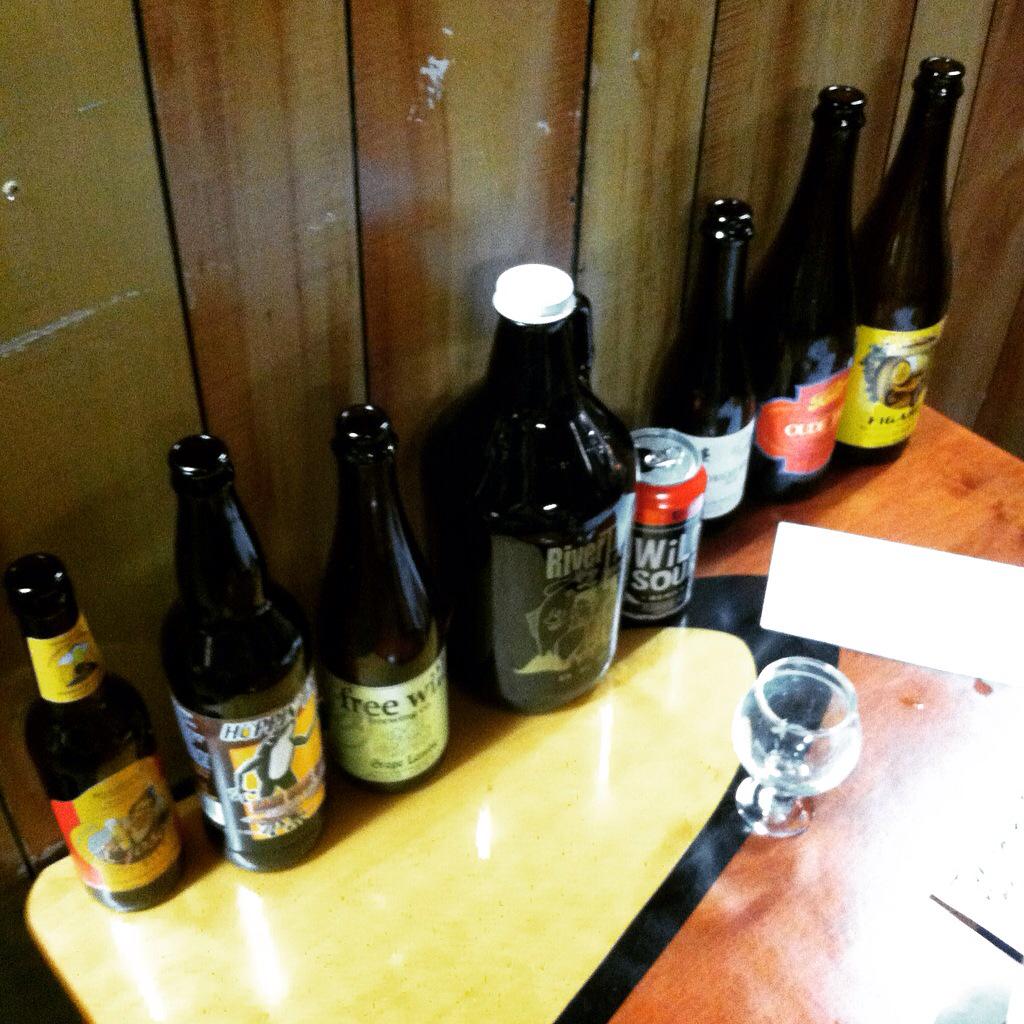
Top Shelf Thursday: The Tart & the Horsey III


Longevity can be fun.  It’s enjoyable to see how something changes the longer you do it, how it evolves & takes on new shapes over time.  Each year, putting together The Sour & the Funky during Pittsburgh Craft Beer Week, new trends emerge, things morph a little year-to-year; this year saw the first Gosen added to the line-up, as well as more local beers & more beers on draft.  So it is with our third “encore” Top Shelf Thursday (unofficially called ‘The Tart & Horsey’), held shortly after PCBW to throw out a little more funk for everyone. 

The German sours tend to get short shrift compared to the Belgians & American wilds, but that’s changing with the waxing popularity of Berliner Weiss, Gose, & other Deutsch obscurities.  We kicked off the night with a beer considered the standard-bearer of the Gose style, Bayerischer Bahnhof’s  Leipziger Gose.  This 4.5% beauty was light, effervescent, with a refreshing tartness & zest from the use of coriander, & could easily accompany one on a summer evening.  Hoppin’ Frog took this esoteric style & imperialized it, ramping the alcohol all the way up to a whopping 6% with its King Gose Home.  Named in honor of Lebron James’ return to the Cavaliers, this mutant Gose hit home with a more assertive tartness than its German uncle.

There’s some controversy about the use of the word ‘lambic’ outside of the Senne Valley, but luckily that heat doesn’t find its way into Free Will’s Grape Lambic.  Fermented with Free Will’s house wild culture, the vinous quality was apparent, & the beer was well-balanced without pulling too hard toward the sour or brett ends of the spectrum.

We were treated to a cool surprise & a first for these Top Shelf Thursday tastings, as not one, but TWO brewers were present to share & discuss the beers they had a hand – or a couple of burly arms – in creating.  Rivertowne’s brew master, Andrew Maxwell, brought his Yinzer Weiss, a blackberry Berliner Weiss fresh outta the tanks.  The beer was sweet & refreshing, with a clear blackberry character & just a kiss of acidity in the finish, ending cool & clean.

Though Belgian in name, Destihl’s Flanders Red also had a Germanic twist on it.  The traditional sweet-tart interplay was given a novel counterpoint by a strong lactic character, ending in a flavor not too far off from sauer kraut (though more appetizing than that sounds, too).  It’s cool seeing the rare sour beer in the can, too.

And our second show-&-tell came from Brendan Benson of East End, who poured Brett Hop, a version of their flagship IPA fermented with brettanomyces & lactobacillus.  The hops married wonderfully with the “wild” fermentation, emphasizing the beer’s floral & lemony aspects.

We stayed in the local vein with Brew Gentlemen’s brett-fermented saison, Loose Seal.  The dance of tropical fruit notes from the yeast & the New Zealand hops was great – we wanted to cry, but didn’t think we could spare the moisture.

Our course got slightly diverted when Perennial’s Aria didn’t want to pour evenly, so we took it to the west coast with Anderson Valley’s Horse Tongue Wheat.  I can see where they got the name – this wheat beer was puckeringly sour from a mix of bugs & time spent in wine barrels.

The brett continued to flow with Allagash’s Midnight Brett Ale.  The recognizably stony, mineral character of the wild yeast was given a unique support in the use of Midnight Wheat malt, offering a comfy, roasty base that bore the brett nicely.

All in attendance braced themselves for the notoriously sour stripe of The Bruery.  Oude Tart takes the acidity of a Flanders Red to a whole new level through extensive aging in oak barrels.

And rounding off the evening was Figaro, a two-plus year old sour blonde from Cascade.  12 months in chardonnay barrels, plus another 12 aging on dried white figs & lemon zest equals one complex beer that balanced an assertively vinous, acidic flavor with a twist of fig sweetness that helps ground it.


So we welcomed some firsts to this Tart, Horsey TST: Gose, more area-sourced beers, as well as the company & knowledge of some of our fine local artisans.  It’s a pleasure to see more new faces, folks finding that the wild world of beer has unexplored nooks & crannies.  And, of course, where would we be without our regulars?  Thanks to all for joining us on another journey, & hope to see you next time.

Thursday, May 7, 2015

Fickle Mistresses


I used to have this fantasy.  It was born of seeing the beer guy at D’s, Hootie, always sporting this Ommegang sweatshirt.  I imagined beer drinkers forming gangs – like, actually street gangs – based on their affinity for breweries, or some other facet of beer culture.  Like, the Dogfish Head crew running into the Stone posse & waging an old-school streetfight, like the mods & the rockers.  I’m not talking about the actual brewers (though I know who I’d put my money on in a Sam vs. Greg match), but the fans, akin to the kind of hooliganism that follows soccer or heavy metal.  Maybe the hopheads, the Belgophiles, & the lager lovers would form separate gangs across the city, & beer fests would turn into riots with heavy security.  What if…

Not that I want to see thug violence besiege the community, but I’m always curious about beer drinkers as a subculture, & kind of thrill at imagining that parallel played out to a surreal extent.  Of course it would never happen, & not just because we’re generally pretty chill, self-regulating, self-policing people (in my experience).  You just don’t see that kind of diehard loyalty to a brand in craft beer.  Craft beer as a hobby is practically defined by playing the field – the more deeply into it you are, the more variety you’ve tried & WANT to try.  Craft beer is the vast continent beyond the mainstream, & once the door’s open, it takes a lot for it swing shut again.  Sure, you might hear that some prefer hoppy beers (or stouts, Belgians, sours, etc.), but that preference is almost never in exclusion to other styles, & doesn’t focus exclusively on one brewer.  You never hear “I’m a Great Lakes man.  Drank it all my life, just like my dad.  Don’t care to try anything else.”  Beer fans are like sharks – they gotta keep moving or they die. 

I imagine there’s a part, however small, of every brewery owner that finds that frustrating.  I remember Mark Thompson of Starr Hill speaking at SAVOR (via Craft Beer Radio) a few years ago.  Amid the beer-bro camaraderie vibe that always flows at these things, there was a little bit of angst in his tone.  At one point he remarked on what a “fickle” lot we craft drinkers are, how challenging it is to keep the public engaged, etc.  And he’s right.  That same angst was behind the hissy-fit Jim Koch threw in that now-famous Boston magazine piece.  As much as craft beer is all about the community as a whole, the little business devils sitting on everyone’s shoulders want to see brand loyalty, to keep them coming back.  There will always be a finite number of go-to beers in everyone’s pocket that we keep returning to, but I don’t ever see a craft brewery commanding “100% share of mind” from its consumers. 

That’s the double-edged sword behind “crafty” beers, the “boutique” brands rolled out by the big companies.  The corporations want to swipe a portion of the craft-curious market, & they’ve been successful.  But diversity breeds diversity, & once  those drinkers have tried Blue Moon or Shock Top, they’re open to many, many other brands that, before, were invisible to them.  Those companies have manufactured their own gate for people to walk right through.  But in the meantime, they’ve still shored up a sizable share in the action. 

That’s why the “Brewed the Hard Way” commercial was just what the big boys needed, right now.  It was to shut that gate & keep the flock right where they are: safe, sound, happy.  It wasn’t an “us too” message, but a “not us, thank you”.  Budweiser is what it is, & if it ain’t broke, don’t fix it – that’s the idea, anyway.  Keep it simple, know what you like.  Ford, NFL, Doritos, Bud.  There IS such a thing as a “Bud man” or a “Coors man”, & they are loyal breeds.  They are the univores who go straight for their brand, & if their brand’s out, leave, no matter that there’s an extremely similar product sitting right next to that empty space on the shelf.*

One of the more memorable scenes from Anat Baron’s movie Beer Wars places her in a bar with brand-loyal Bud/Miller/Coors fans.  On a table are three cups of beer, one each of the afore-mentioned.  She asks participants in an experiment to state which of the big three they drink, has them taste all three beers, & try to identify which one is “their” brand.  Unsurprisingly, everyone fails, demonstrating the fallacy of brand loyalty with such a homogenous product.  But it doesn’t really matter if they can pick it out – the tie has already been established.  There’s something about that beer that makes it theirs, & no doubt those blind taste testers have already downed hundreds of that brand, & will likely continue.

I, personally, don’t see myself becoming brand-loyal any time soon.  Sure, there are breweries I get excited about (I get psyched any time Lagunitas unveils something new).  But I always go back to the comfort of playing the field.  There’s too much out there, & I’m not ready to settle down yet.  And I bet a lot of you are out there with me.  Here’s to choice, & hoping the supply side keeps it coming. 


*Part of me hates using this “us/them” tone.  It’s presumptuous of me to speak like I know who you, the reader, are, but I’ve done it before & will probably keep doing it.